


If you are tired of framing shots perfectly before hitting record, a 360 degree action camera might be the game-changer you have been searching for. Unlike traditional action cameras that capture a fixed field of view, these immersive devices record everything around the lens simultaneously, giving you the freedom to reframe, rotate, and explore every angle long after the shot is taken. Whether you are a content creator chasing viral travel videos, an athlete documenting extreme stunts, or a traveler who wants to preserve the full sensory experience of a destination, 360 action cameras open up a creative dimension that nothing else quite matches. In this comprehensive guide, we will dive deep into how these cameras work, which models dominate the market, what features truly matter, and how you can shoot breathtaking immersive footage like a professional.
What Is a 360 Degree Action Camera?
A 360 degree action camera is a compact, rugged imaging device equipped with multiple wide-angle lenses — typically two opposing fisheye lenses — that capture a full spherical view of the surrounding environment in every direction. The built-in processor then stitches these individual lens feeds together seamlessly into a single equirectangular image or video. The result is a fully immersive panorama that viewers can scrub, pan, and explore interactively on a screen or in a virtual reality headset.
These cameras are purpose-built for on-the-go shooting in environments where you cannot pause to adjust angles. From mountain biking trails to underwater coral reefs, from bustling city streets to behind-the-scenes backstage moments, a 360 degree action camera ensures that no moment is missed because the entire world around you is always being recorded.
How 360 Action Cameras Work: The Technology Behind Immersive Footage
Understanding the inner workings of a spherical camera helps you appreciate why the results can be so impressive — and where limitations might arise.
- Dual or Multi-Lens Capture: Each lens records a wide hemispherical view, often around 200 degrees or more per lens. The overlapping zone in the center is where the stitching engine does its work.
- Real-Time Image Stitching: The onboard processor merges the two (or more) lens feeds using complex algorithms that align edges, correct exposure differences, and blend color profiles so the transition is invisible to the viewer.
- Software Reframing: Because the entire sphere is captured, you can select any portion of the footage in post-production and stabilize, crop, or track a specific subject without losing resolution from the original capture.
- Stabilization Algorithms: Modern 360 cameras use electronic image stabilization combined with gyroscopic data to smooth out shaky footage, even when you are hiking, skiing, or riding a motorcycle at high speed.
Top 360 Degree Action Cameras in 2024
The market for immersive cameras has matured significantly. Here are the standout models leading the space right now.
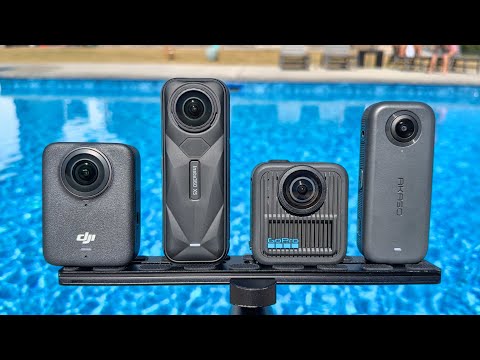
- Insta360 X4: The current benchmark for consumer-grade 360 cameras. It shoots 8K 360 video, features a 1/2-inch sensor, FlowState stabilization, and a modular design with interchangeable lenses and accessories. Its Invisible Selfie Stick effect makes the pole vanish from the shot entirely.
- Insta360 RS 1-Inch 360 Edition: Built on the modular Insta360 Rise platform with a full 1-inch sensor sensor, offering significantly better low-light performance and cinematic depth of field compared to smaller sensor models.
- GoPro MAX: GoPro’s entry into the 360 space, offering 5.6K 360 recording, HyperSmooth stabilization, and the ability to toggle between 360 mode and traditional linear wide-angle footage — all in one rugged, waterproof body.
- Ricoh Theta X: A favorite among still photographers who want a compact 360 camera for virtual tours and real estate walkthroughs, featuring improved low-light performance and built-in GPS.
- Kandao Obsidian: Geared toward creators who need advanced spatial video capabilities for VR content creation, with dual 1/2-inch sensors and high dynamic range processing.
Key Features to Evaluate Before Buying
Not all immersive cameras are created equal. Here is what you should prioritize based on your shooting needs.
Resolution and Frame Rate
Resolution directly affects how much you can reframe your footage after capture. An 8K 360 video gives you enough pixels to punch in on a specific area and still deliver a sharp 4K output. Frame rate matters especially for action sports — look for cameras that shoot at least 60fps at your target resolution so that slow-motion playback remains smooth and fluid.
Stabilization and Software Stitching Quality
This is where premium models separate themselves from budget options. Poor stitching shows visible seams, ghosting around moving objects, and exposure mismatches between lens halves. High-end cameras use AI-powered stitching engines that reduce these artifacts dramatically, even in challenging conditions like fast motion, low light, or high-contrast scenes.
Waterproof and Rugged Design

Most 360 action cameras are rated for underwater use without an external housing — often to depths of 10 to 16 feet. For deeper dives or more extreme environments, check whether the manufacturer offers optional protective cases that maintain full lens functionality.
360 Action Camera vs Traditional Action Camera: A Side-by-Side Comparison
Understanding the trade-offs helps you decide which tool fits your creative workflow.
| Feature | 360 Action Camera | Traditional Action Camera |
| Field of View | Full spherical — every direction | Fixed wide-angle, typically 120–170 degrees |
| Post-Shoot Flexibility | Extremely high — reframe any angle | Limited — what is framed is what you get |
| Hidden Stick Effect | Yes — pole or hand disappears | No — rig is always visible |
| Low-Light Performance | Generally weaker due to small sensors | Better with larger single sensors |
| File Size | Very large — 8K 360 files are massive | Smaller and more manageable |
| Ease of Use | Point and shoot — no framing needed | Requires careful composition each time |
| Best For | Immersive content, vlogs, VR, behind-the-scenes | Narrative shots, travel clips, social media reels |
Best Use Cases for a 360 Camera
The versatility of a spherical camera opens up applications that traditional cameras simply cannot replicate.
- Adventure Sports Documentation: Mount the camera on a helmet, chest harness, or handlebar and capture every angle of your ride, run, or jump simultaneously. The camera becomes virtually invisible, leaving only the action in frame.
- Travel Vlogging: Instead of holding your camera out in front of you awkwardly, clip it to your backpack or chest and walk freely through markets, temples, and streets. Viewers can look around the scene themselves.
- Virtual Tours and Real Estate: Real estate agents and hospitality businesses use 360 cameras to create walkthrough experiences that let potential buyers or guests explore spaces remotely.
- Content Creator and Social Media: Platforms like YouTube and Meta now support 360 video uploads. Spherical content stands out in feeds and drives significantly higher watch time because of the interactive element.
- Training and Safety Recording: Industries from construction to emergency response use 360 capture for after-action reviews, allowing supervisors to examine exactly what each worker saw during an incident.
Expert Tips for Shooting Incredible 360 Footage
- Keep the Camera at Eye Level When Possible: Even though 360 cameras capture everything, placing them at a natural sightline avoids an awkward, disorienting viewing experience for your audience.
- Mind the Stitch Zone: Objects or people positioned directly at the lens junction where the two lenses meet can appear distorted or partially cut during stitching. Keep your main subjects away from that dead zone.
- Use Natural Light Strategically: Because 360 cameras have small sensors, they struggle in very low light. Shoot during golden hour or seek well-lit environments for the cleanest results.
- Shoot Longer Clips for Better Editing Flexibility: Capture more footage than you think you need. The beauty of a 360 camera is that you can extract multiple usable clips from a single take by reframing different sections.
- Use a Quality Microphone or External Audio Source: Built-in mics on 360 cameras often pick up handling noise and wind. A small clip-on lavalier or directional mic mounted nearby dramatically improves audio quality.
- Edit with Purpose: Use the reframing tools in apps like Insta360 Studio, GoPro Quik, or Adobe Premiere Pro to lock onto your subject and create a polished, traditional-looking final product from raw spherical footage.

Frequently Asked Questions
What is the best 360 degree action camera for beginners in 2024?
The Insta360 X4 is widely considered the best starting point for beginners. It delivers outstanding 8K 360 video quality, has an intuitive companion app for easy editing and sharing, and its Invisible Selfie Stick feature means you do not need to worry about perfect framing. The learning curve is minimal — mount it, press record, and explore your creative options in post-production.
Can you use a 360 action camera for VR content?
Absolutely. Many creators use cameras like the Kandao Obsidian or Insta360 RS 1-Inch Edition to produce spatial video and VR experiences for headsets like Meta Quest and Apple Vision Pro. For true VR-quality content, look for cameras that shoot at high bitrates with minimal stitching artifacts, as viewers in a headset are much less forgiving of visible seams or exposure inconsistencies.
How do 360 cameras compare to drones for capturing wide scenic views?
While drones offer a unique bird’s-eye perspective, 360 cameras capture an entirely different experience — one where the viewer controls where to look rather than being guided by a camera operator. The two tools complement each other well, and many outdoor content creators use both: drones for sweeping aerial establishing shots and 360 cameras for immersive ground-level storytelling.
If your content strategy involves engaging, interactive experiences that boost watch time and shares, the investment pays for itself quickly. Platforms reward immersive content with higher algorithmic promotion. The ability to extract multiple unique clips from a single shoot also saves time and increases your content output without additional shooting sessions.
What should I look for in waterproof 360 camera accessories?
When shopping for accessories, prioritize mounts made from corrosion-resistant materials like anodized aluminum or reinforced polycarbonate. Look for adhesive mounts that bond securely to wet or curved surfaces, and always confirm that the accessory does not obstruct the camera’s lenses. Floating hand poles are also highly recommended, as a 360 camera dropped in water can be nearly impossible to spot in waves or murky conditions.
Final Thoughts
A 360 degree action camera is far more than a novelty gadget — it is a serious creative tool that transforms how you capture and share experiences. From the effortless point-and-shoot convenience to the staggering post-production flexibility that comes with capturing an entire sphere, these cameras empower creators at every skill level to produce content that feels genuinely immersive and unforgettable. Whether you choose the industry-leading Insta360 X4, the versatile GoPro MAX, or a specialized model for VR production, the key is to start shooting and experiment with reframing techniques. The more you practice, the more you will unlock the true potential of spherical storytelling. The world is all around you — now you can capture all of it.